
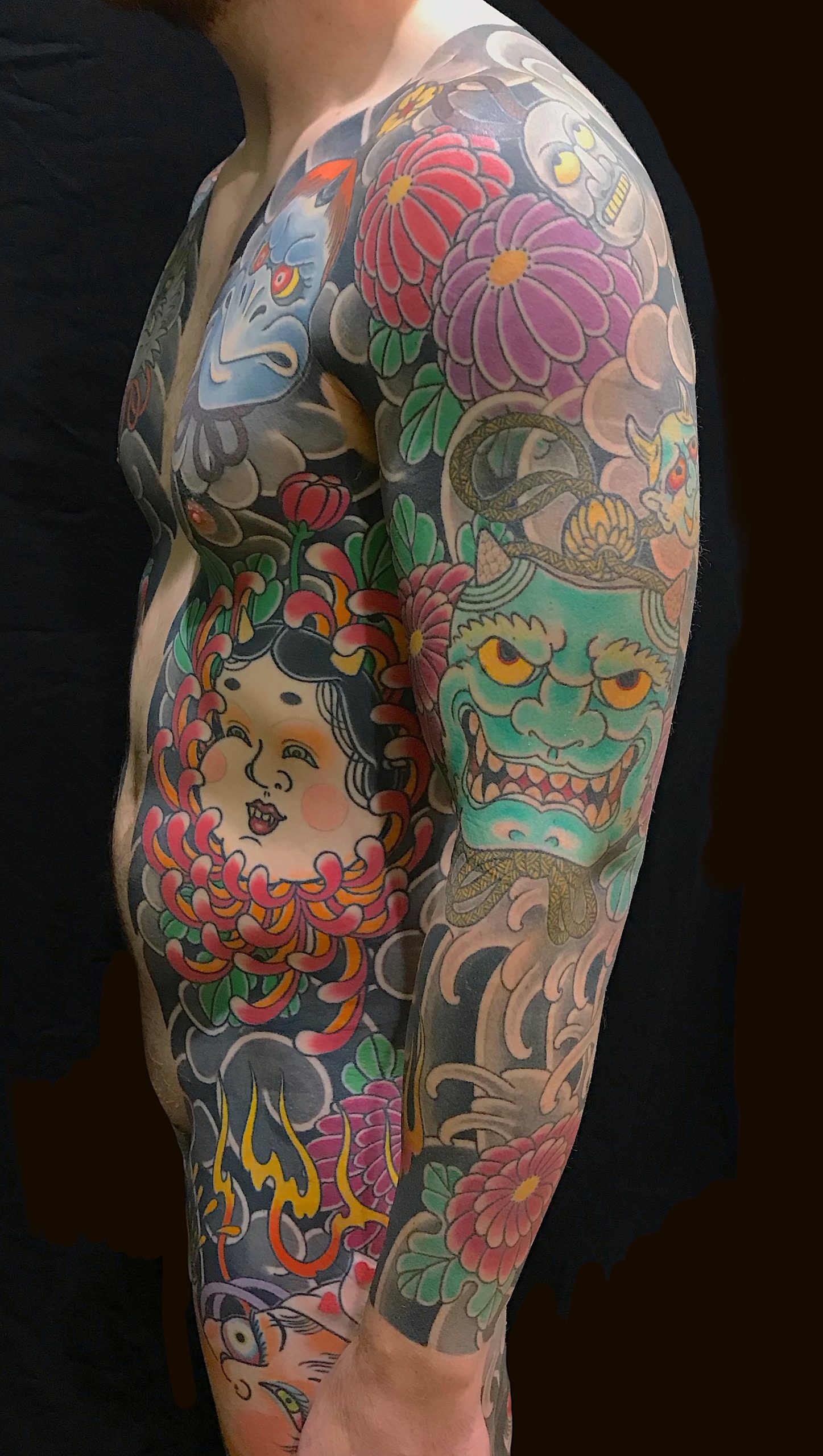
Balance in Japanese body suit tattooing is structural. That structure and flow are what make the work look the way it does. You treat it as a preference, you get inconsistent results. Structure creates consistent balance.
A lot of artists who do Japanese work have never built a body suit. They’ve done sleeves. They’ve done back pieces. But a body suit is a different challenge entirely, and balance is where that difference shows up.
Every decision you make in session one carries forward into every session after it. The flower you pick, the way you think about color, the imagery you choose. All of it is made with the full body in mind, even when there’s no finished plan yet.
What Balance Actually Means at Body Suit Scale
Balance is symmetry, but it’s symmetry that moves. The eye travels through the composition and the balance travels with it.
When one side of the body is heavier in imagery, color, and background, it overpowers the other side. Same thing happens top to bottom. If you have large peonies on one arm and cherry blossoms on the other, the peony side dominates. Peonies are larger flowers. They demand your eye’s attention. The cherry blossoms can’t compete.
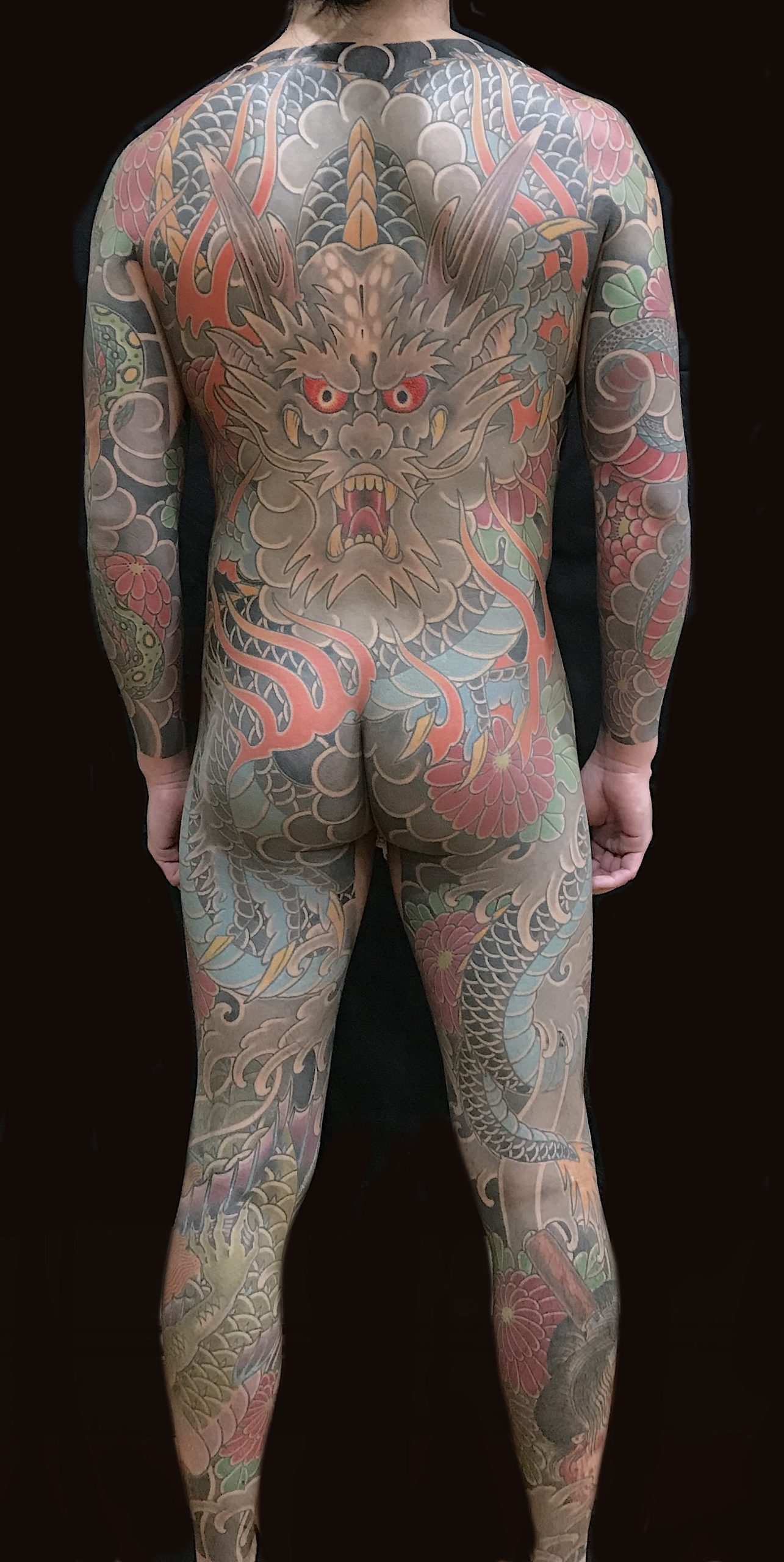
A body suit is a unified composition, not a collection of individual tattoos. The back is the structural and visual center, and everything else has to answer to it.
Certain surfaces of the body get seen together at the same time, so the imagery on those surfaces has to work as a unified composition. Clouds on one side, waves on the other. That doesn’t work. They’re on the same viewing plane. It doesn’t make sense visually. Background is filler. It’s filler that creates structural balance, and when it’s inconsistent across the body, the whole composition feels wrong.
That’s why the very first decision matters so much.
The Flower Rule and Why It Matters
The flower you pick in session one becomes the filler for all future work. I bring this up in the consultation.
Japanese tattooing is organized by bloom. Each flower has its own individual bloom moment, celebrated separately. One flower, one bloom, one body. The flower balances the weight across the whole suit. Mixing cherry blossoms on the arms with peonies on the back creates imbalance both in size and color.
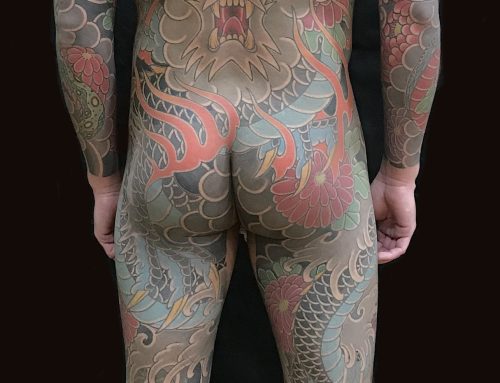
You only see the arms from one angle with the back, so the connection point is small. The legs are different. The back flows directly into them, and you see both surfaces together. When you’ve got different flowers between the back and legs, one will overpower the other. Just like the peony and cherry blossom: both in size and color, one dominates.
The flower you choose goes throughout your whole body. I tell clients that upfront. I’ve done mixed flowers before when clients insist, but that’s not my standard. If someone comes in with existing work that has different imagery, I assess what’s there and incorporate it into the plan. When an artist doesn’t lock that in, they’re setting up every future session to fight against what’s already there.
Color as Weight, Not Decoration
Color isn’t just decoration. It’s weight. A heavily saturated red dragon on the back creates a demand on every other surface of the body.
Every color decision I make has to account for the full suit, not just the session I’m working on. Color creates weight on one part of the body that has to be balanced somewhere else. You can’t treat it like decoration and expect the suit to hold together.
Background as Filler That Creates Balance
Background is filler. But it’s filler that holds the composition together across every surface of the body.
Waves, wind bars, clouds, maple leaves, peonies, chrysanthemums. That’s the filler between the main images. When the background is wrong, the suit feels unresolved regardless of how technically clean the individual images are.
Heavy background on one side and open skin on the other creates imbalance the eye registers. Background transitions are filler that prevents the eye from getting stuck and creates smooth flow across surfaces.
Why the Artist’s Knowledge Builds the Suit
Most body suits start with a sleeve. They’re not planned in full up front.
What turns a sleeve into a complete, balanced body suit is the artist’s knowledge. Knowing how to add onto existing work, direct the client, and suggest images that go well with what the client already has. That consideration and knowledge is what saves a client from an unbalanced, mismatched, pieced-together body suit.
If an artist only has sleeves in their portfolio, the odds they know how to set a body suit up for success down the line are probably pretty limited. That’s the real line between a sleeve artist and a body suit artist.
A lot of artists who do Japanese work haven’t done it at the volume or depth required to understand this. Some of my California clients have been in progress for nearly two decades. You learn things over that timeline that you can’t learn from doing sleeves.
Leave A Comment