
Thirty years into tattooing, I can usually tell within the first conversation whether someone in my chair is getting one piece or starting a body suit. Most of the time they can’t tell yet themselves.
That’s fine. My job includes seeing it before they do.
I run Katana Tattoo in Green Bay, and almost everything I do is large-scale Japanese work: sleeves, back pieces, full suits. People drive in from Chicago, Milwaukee, and Minneapolis for it. And the single biggest thing I’ve learned about this work is simple.
The line between a one shot and a body suit gets drawn in the first session. Whether you know it or not.
Once You Get Into It, You’re Going to Want More
In thirty years, this plays out the same way every time.
Someone comes in for one big piece. A sleeve, usually. They heal it, they live with it, they see how it sits on their body. And then something clicks. It only seems natural to at least balance out the body.
This happens organically. I don’t have to sell anyone on it.
Once you get into tattooing, you’re going to want more. And then those little ones are just going to be in the way.
That’s why I think walk-in pieces are a dying format for serious collectors. In five to ten years, informed clients will skip the small stuff entirely, because they’ll understand that every little random piece is future canvas they just gave away.
I have a full body suit myself. I know what this progression feels like from the inside. That shapes how I approach every first appointment.
I’m Already Thinking About Your Body Suit
You come in for a sleeve. I’m already planning your body suit. I mean, even if you never get one, I plan like you will.
Here’s why. The decisions you make in session one either keep all the doors open or close them. And the biggest one is the flower.
The Flower Rule
The flower you choose is going to go throughout your whole body. I tell every client this at the start, before we draw a single line.
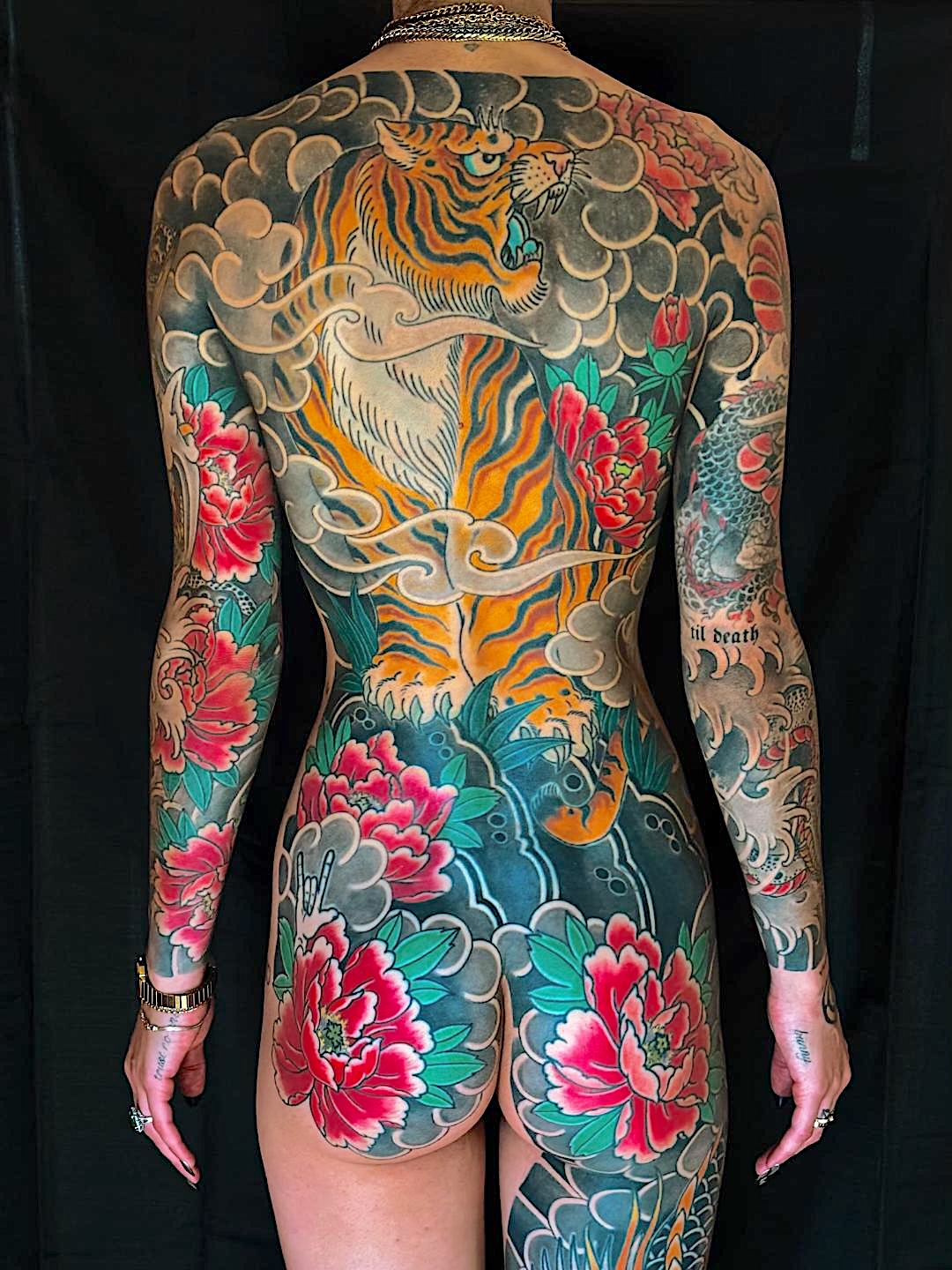
Japanese tattooing runs on seasons. One flower, one season, one body. Put peonies on one arm and cherry blossoms on the other and you’ve created a problem you can’t fix. Peonies are a heavier flower. They’ll dominate. The composition tips sideways and stays that way forever.
Flowers are basically like firecrackers for your whole body. They bring everything together across pieces done years apart. Get that decision right on day one and every future piece has a home. Get it wrong and someone has to undo it later.
Protecting Your Canvas
The second thing I do is talk clients out of using all their ideas at once.
People show up with five images they love and want them all in one sleeve. I tell them to pick two or three main images and save the rest.
You only need one or two main images and one filler image, usually a flower or a leaf. The rest of the images you like? Save them. They’ll work for future pieces. I’ll tell you which ones fit what you’re getting now and which ones are better used later.
When I tell a client to hold an idea back, I’m thinking ahead for them. The more you educate them up front, the better every piece down the line turns out.
The Back Piece Is the Commitment Point
The back is where it gets real.
The back piece is the main event. Everything else is built to frame it.
This is also where the work gets hard. Arms and legs are cylinders. Cylinders create natural flow. Wrap an image around a cylinder and the body does half the compositional work for you.
The back is flat. It reads as one single surface, like a painting. You get no help from the anatomy. Composition, weight, directionality. All of it has to be built deliberately. This is the exact spot where body suits fail when the artist doesn’t understand what a flat plane demands.
A sleeve and a body suit run on different timelines entirely. Some of my California clients have been in progress with me for almost two decades.
How I Plant the Idea Without Saying a Word
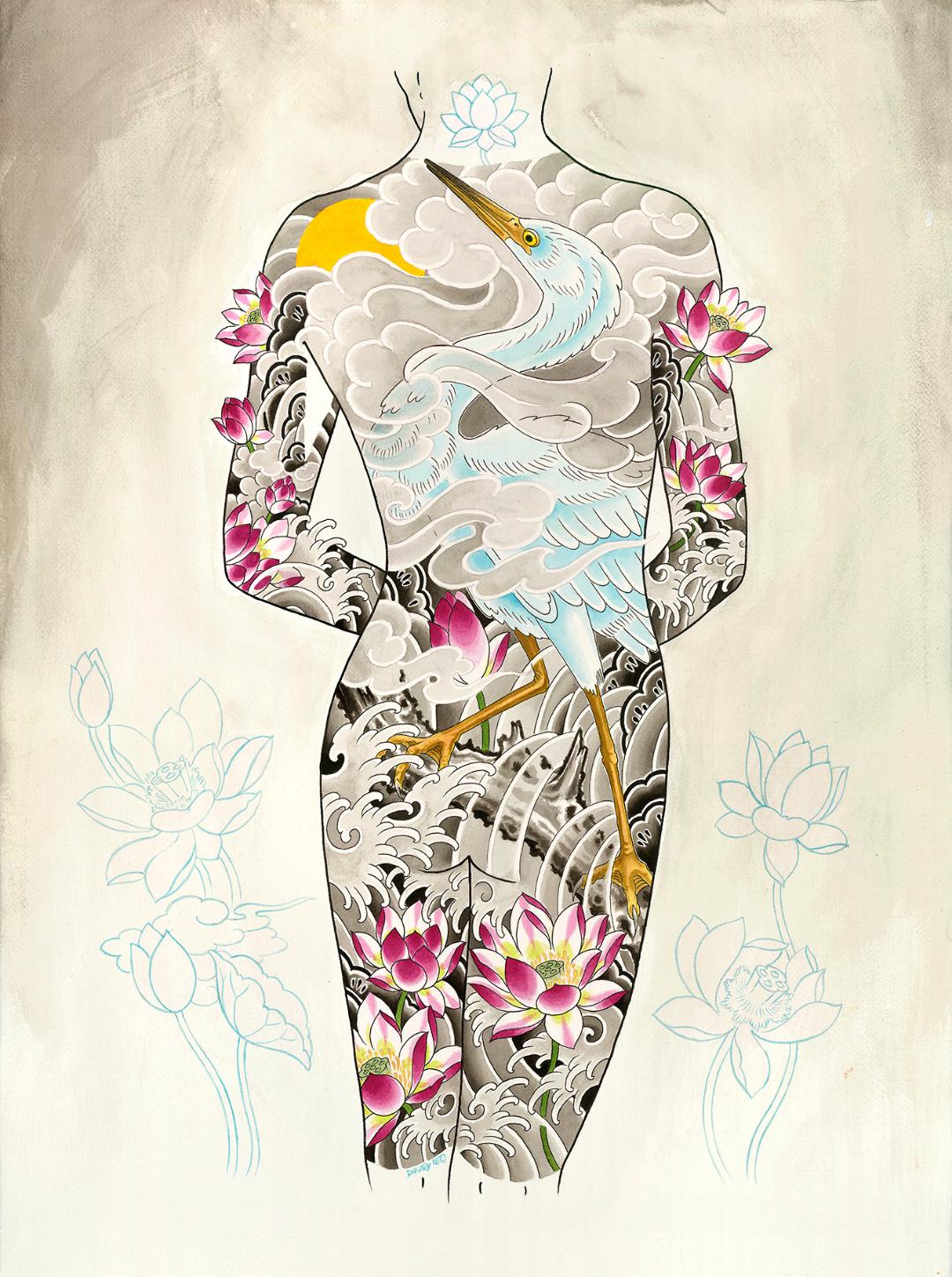
I hang life-size body suit paintings in my shop.
Clients come in for a sleeve consult, and while we’re talking, they’re looking at a full suit at human scale. Nobody has to pitch anything. The painting does the work. And then while I’m tattooing them, I can reference it directly, show them how things need to flow.
The rest of my process backs that up:
- I pick their brain first. Aggressive or chill. Human figures or animals. The attitude of the suit comes before any specific image.
- I photograph their body before designing. Muscle definition, folds, stretch marks. Real topography changes what an image can do, and an iPad won’t show you any of it.
- I draw on skin. The body reveals itself in person. The distance between joints, the way muscle moves, all of it.
- I sequence multi-day sessions so the most painful areas get done fresh on day one, and I never go back into skin I worked the day before.
- I give honest time frames. A sleeve runs 20 to 25 hours on average. A back is a much wider range. I just tell them what it actually takes so they can plan.
Every one of those steps is me thinking further ahead than they are. That’s the whole point.
Cover-Ups Are Canvas Clearing
People think cover-ups are just fixing bad tattoos. That’s not really it.
When a body suit client comes in with old random pieces, they don’t love that work. That’s why they’re covering it. It’s in the way of where the suit needs to go. So we clear it.
That’s the real cost of the little walk-in pieces people collect early on. Each one is future canvas they already spent.
What This Actually Takes
I know how some of this sounds, and I’m sorry to sound egotistical, but the point stands. There are hundreds of hours of dedication behind what I do, and not many people are willing to put in that time anymore.
The craft, meaning the technical act of tattooing, is learnable now. YouTube, Amazon, weekend seminars. The art is something else. Flow, composition, body topology, knowing what a flat back demands versus what a cylinder gives you for free.
And I’m still adjusting it. There’s never a point where you plateau. If you do plateau, you either got lost in it or got bored with it. I keep making small changes and finding what makes the work stronger.
The Line Is Drawn on Day One
Look at the art you want. Think about how you would add to it. Does it fit your body, or does it just look cool on paper? All of those things will alter your future work. And in tattooing, once it’s there, it’s there. It’s for life.
Leave A Comment